𐄀 Technology Connection to Future


The global transition toward renewable energy has made Battery Energy Storage Systems (BESS) a corner stone of modern power grids. From compact commercial and industrial (C&I) setups to massive multi-megawatt containerized installations, these battery banks keep power flowing smoothly. However, the multi-million dollar efficiency of these systems often comes down to the smallest components: the heavy-duty plugs and sockets that tie everything together.
Inside a battery bank, the energy storage connector has a massive job. It must transfer huge amounts of electrical current all day long under changing temperatures and harsh outdoor environments. If these joints fail, the whole power grid suffers from downtime. This guide skips the academic jargon and breaks down exactly how these components work, what keeps them safe, and how to choose the best ones for your project.

To understand how a high-quality industrial energy storage connector works, you only need to look at one basic rule of electricity: P = I * I * R. In plain terms, this means that the heat generated at a connection point equals the current multiplied by itself, then multiplied by the contact resistance.
Modern energy storage systems do not deal with small electronics. They run on massive continuous currents, often between 100A and 400A or higher. Because the current (I) is multiplied by itself in the formula, any increase in current causes an exponential jump in heat.
If you double the current, the heat multiplies by 4.
If you increase the current by 10 times, the heat spikes by 100 times.
Since you cannot change the high current required by the system, the only way to keep the connection from melting or catching fire is to force the resistance (R) down as low as possible. Industry leaders solve this by using premium copper alloys coated with high-grade silver plating and designing specialized internal spring terminals (like crown band or louvred springs). This maximizes the physical surface area where the plug meets the socket, keeping the contact resistance under a fraction of a milliohm. This smart engineering keeps the system running cool and prevents dangerous thermal runaway.
High-voltage battery racks remain live and dangerous even when the main system is shut down. Because technicians must install and service these racks regularly, a reliable industrial energy storage connector must feature built-in, foolproof safety mechanisms to protect people and prevent catastrophic short circuits.
Touch-Proof Insulation (IP2X Design): Live metal pins must never be exposed to human hands. Premium connectors use an IP2X touch-proof design, which adds a physical plastic shield around the energized parts. This ensures that a technician's finger or a dropped metal tool can never accidentally touch the high-voltage circuits, eliminating the risk of lethal shocks.
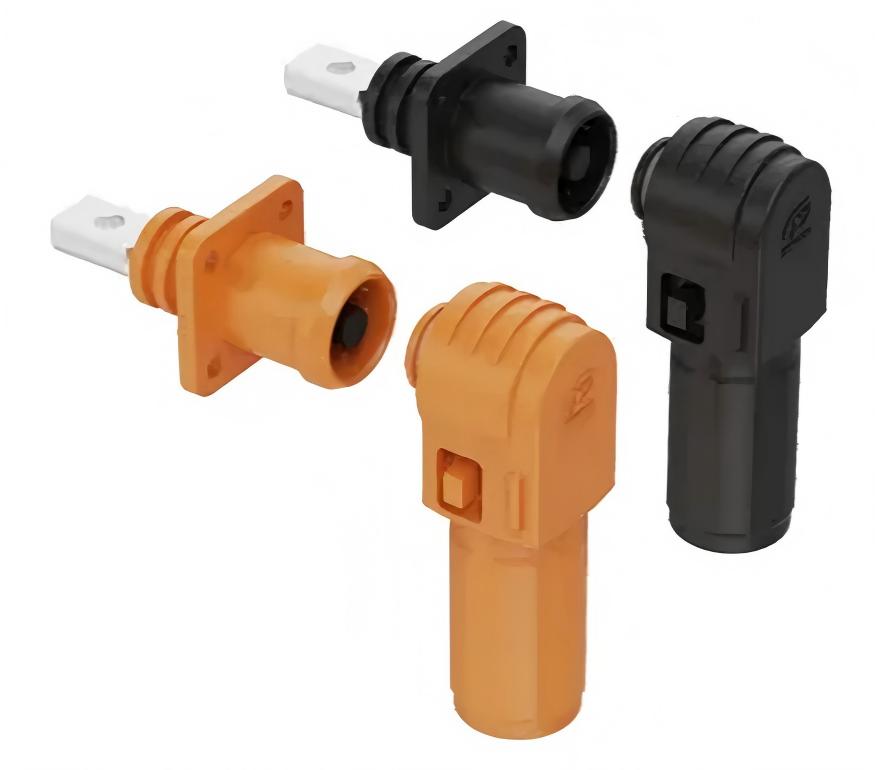
Physical Keying and Color Coding: Accidentally plugging a positive cable into a negative terminal will instantly destroy expensive battery modules and cause immediate explosions. To prevent human error on busy job sites, connectors use a double-verification system: bright color-coding (usually orange for positive and black for negative) combined with unique physical slots. A positive plug physically cannot fit into a negative socket, making installation completely foolproof.
Audible Positive Latching: High currents create magnetic forces, and transit or cooling systems create constant physical vibrations. If a cable wiggles loose while carrying hundreds of amps, it will create a massive electrical arc that can melt the equipment. Modern connectors use quick-lock buttons that emit a clear, audible "click" when fully mated, ensuring the lock is 100% secure.
Every energy storage project has unique requirements. Choosing the wrong component class can either break your budget or lead to premature system failure in the field. The matrix below simplifies the main selection criteria for project planners:
| Operational Requirement | Commercial & Industrial (C&I) Systems | Containerized Utility BESS |
|---|---|---|
| Current Capacity Range | 100A to 200A continuous | 250A to 400A+ continuous |
| Maximum Voltage Rating | Up to 1000V DC | 1500V DC and above |
| Mating Form Factor | Manual cable-to-board plug-in | Quick-snap rack mount / Blind-mate backplane |
| Environmental Protection | IP20 (Indoor cabinets) / IP54 (Protected) | IP67 up to IP69K (Heavy-duty outdoor) |
| Core Safety Compliance | UL 1977, CE | UL 4128 (Dedicated BESS standard), TUV |
Beyond the core numbers in the matrix, you must consider the outer shell material. Since utility BESS containers are set up outdoors in desert solar fields or humid coastal wind farms, the plastic housing must use top-tier polymers like PA66 with advanced UV stabilization. This keeps the plastic from cracking under brutal sunlight and ensures it meets the UL94 V-0 flame-retardant standard. Furthermore, the terminals must be rated for hundreds of plug-in cycles without losing their tight grip, preventing maintenance headaches over a 15-year operational lifecycle.
For engineering teams working on broad, high-power clean energy projects, components cannot exist in isolation. Modern industrial hubs, microgrids, and green transit depots often require stationary battery storage arrays to work hand-in-hand with mobile vehicle fleets.
For instance, the high-voltage lines running from outdoor containerized battery stacks into a facility’s power distribution matrix often cross paths with high-power heavy transport charging lines. Selecting a component partner who designs all of these systems under the same rigorous engineering tolerances prevents signal lag, power drops, and mechanical mismatching along the line. Exploring our diverse heavy-duty industrial and e-mobility lines on our official homepage gives project specifiers a streamlined way to harmonize full-site electrical architectures.
Finding a zero-defect supplier means looking for extensive field experience. Yonggui Electric Equipment Co., Ltd. (YGC) leverages decades of high-reliability manufacturing history to supply world-class connectivity products globally. YONGGUI's field-proven industrial energy storage connector options are precision-built to meet the strict demands of global tier-1 BESS integrators. By combining advanced metallurgical silver-plating with ultra-tight spring terminal tolerances, YONGGUI keeps your system operating at peak efficiency under the toughest industrial conditions.
In summary, choosing the right energy storage connector requires looking closely at low contact resistance, foolproof touch safety, physical lock integrity, and rugged weather resistance. Investing in certified, field-tested industrial energy storage connector designs allows system integrators to drastically lower their Levelized Cost of Storage (LCOS), eliminate dangerous overheating risks, and keep field operators safe. Partnering with a manufacturing leader like YONGGUI ensures your green energy investment remains highly profitable and completely secure for decades to come.
Whether you are finalizing a new commercial battery module blueprint or sourcing heavy-duty plugs for a utility-scale outdoor BESS layout, YONGGUI’s dedicated engineering team is here to help. Contact Our Experts Today to receive custom configuration consultations, detailed engineering drawings, or a competitive factory quote.
When high currents pass through the connector, any microscopic contact resistance creates heat based on Joule effect. High-quality connectors use silver plating to drop this resistance and keep temperatures safe.
An IP2X rating means the connector housing has integrated plastic barriers that physically stop a technician's finger or a stray metal tool from touching live, high-voltage parts, preventing accidental electrocution.
The bright orange and black colors give clear visual guidance, while unique physical keying slots physically stop a positive plug from being inserted into a negative socket, eliminating polarity mistakes.
Without an audible quick-lock or latch, constant vibrations can cause the cable to back out slightly. This creates a highly dangerous electrical arc that can melt the connector housing and trigger fires.
Yes. YONGGUI provides fully customized, custom-engineered energy storage connection assemblies and cable harnesses tailored to your specific voltage, current capacity, and spatial footprints.

 English
  日本語
日本語  Deutsch
  ไทย
ไทย  русский
  العربية