𐄀 Technology Connection to Future
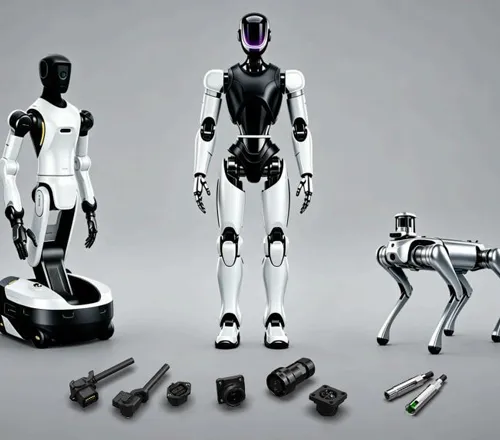


A full-system connectivity approach covering perception, communication, actuation, power, control, structural feedthrough and cable assembly integration
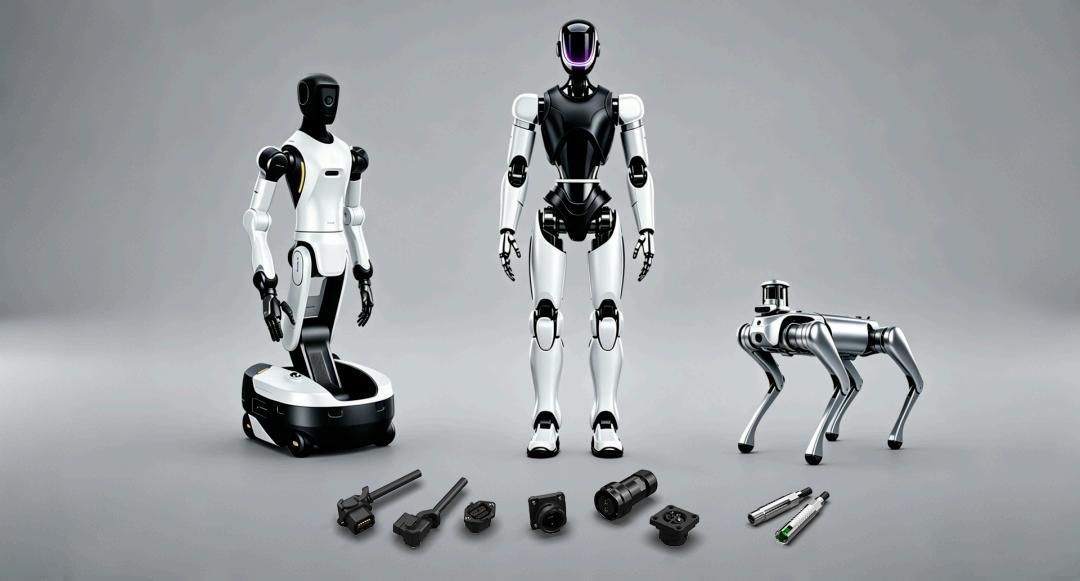
Interconnect systems support signal, power and data pathways across embodied robot platforms.
As embodied robots move from laboratory prototypes to scaled deployment, the reliability of thousands of internal connection points becomes a decisive factor in system performance. Unlike conventional electronics, robots must maintain uninterrupted signal and power transmission under continuous vibration, repeated bending, temperature variation and electromagnetic interference.
Inside a robot, connectors form the pathways between perception modules, computing and control units, joint actuators, battery systems and end-effectors. A momentary contact interruption or signal loss can affect the coordination of the entire machine.
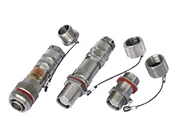
Yonggui has developed an internal full-pathway interconnect portfolio for embodied robots, covering precision connectors, power and signal interfaces, control connectors, structural feedthrough solutions and integrated cable assemblies.
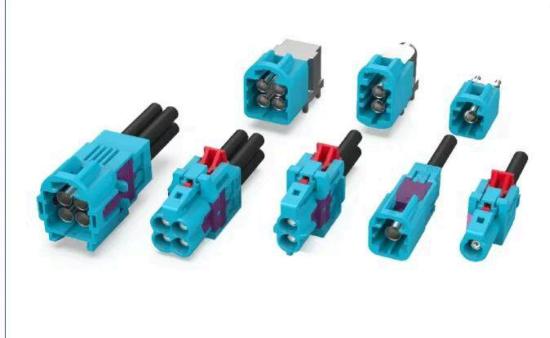
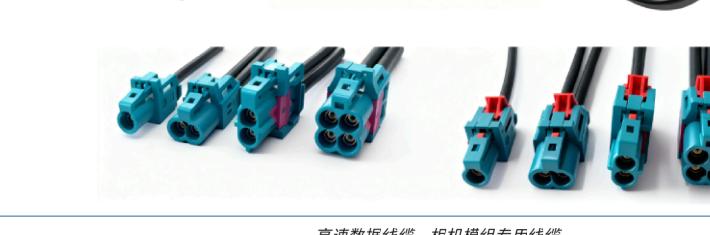
mini-Fakra Connector | mini-Fakra ConnectorDesigned for compact RF and high-speed data links in camera modules, sensors and perception systems.
Key specifications: frequency range up to 15-20 GHz; data transmission rate 20-28 Gbps; retention force over 80 N; 50 Ω characteristic impedance; -40°C to +105°C operating temperature; RoHS compliant. |
HESD Ethernet Series Connector | HESD Ethernet Series ConnectorA single-pair Ethernet connector series for high-speed communication links inside robotic systems.
Key specifications: frequency support up to 20 GHz as described in the source article; contact resistance: inner conductor ≤10 mΩ, outer conductor ≤7.5 mΩ; insulation resistance ≥100 MΩ; -40°C to +105°C operating temperature; RoHS compliant. |
Rotary joints and linear joints are core motion units in embodied robots. Each joint module must carry drive current and precision encoder signals while supporting coordinated motion across the full body. Yonggui provides multiple connector options for joint break-point locations, and each product series has its own application focus.
RFJ Series 202 Connector | RFJ Series 202 ConnectorA precision connector for integrated power supply and control-signal transmission in robot power modules.
Key specifications: 2+2 cores; rated voltage: 100 V DC; rated current: power pin 25 A, signal pin 2 A; withstand voltage 500 V; insulation resistance ≥500 MΩ; mechanical life 100 cycles; -40°C to +105°C; IEC61984 and IEC60664-1. |
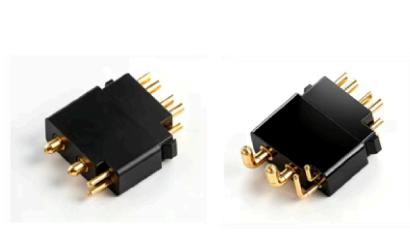
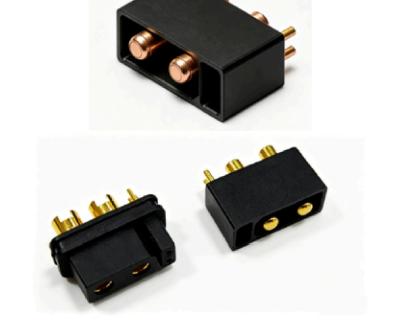
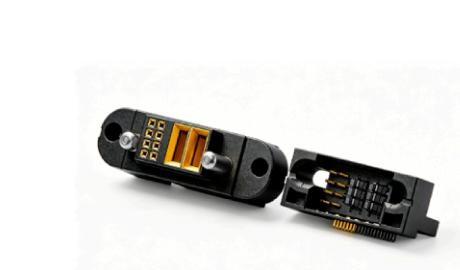
RF Series 2+2 Joint Motor Connector | RF Series 2+2 Joint Motor ConnectorA joint motor connector developed from the XT connector platform for compact power-and-signal integration.
Key specifications: pin specifications φ3 and φ0.8; rated current: power pin 30 A, signal pin 1 A; rated voltage 150 V DC; withstand voltage 1500 V AC 50 Hz; -40°C to +125°C; IP40; UL94 HB. |
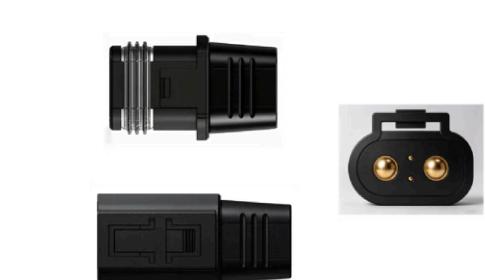
(2+2) Connector | (2+2) ConnectorA protected 2+2 connector variant designed with locking and waterproofing features for demanding joint applications.
Key specifications: rated current: power pin 20-45 A, signal pin 1 A; withstand voltage 1500 V AC 50 Hz; mechanical life 100 cycles; -20°C to +120°C; IP67. |
Robots require reliable energy pathways between battery packs, charging interfaces and onboard systems. This layer focuses on stable current transmission, safe mating, compact installation and long-term durability under repeated operation.
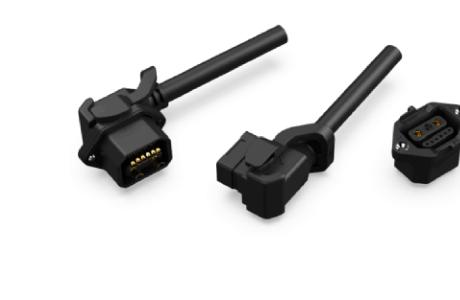
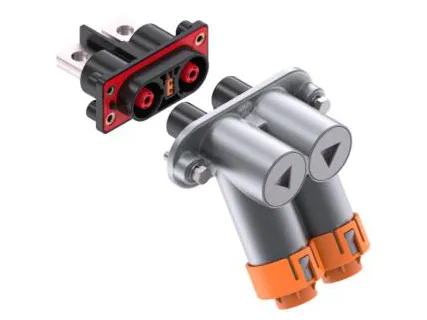
RF-(2+6) Connector | RF-(2+6) ConnectorA non-detachable battery charging interface connector for humanoid robot power modules.
Key specifications: 2+6 cores; rated current: power 40 A, signal 1 A; rated voltage: power 100 V, signal 5 V; withstand voltage 500 V; insulation resistance ≥500 MΩ; contact resistance: power <0.75 mΩ, signal <5 mΩ; -40°C to +75°C; IP67. |
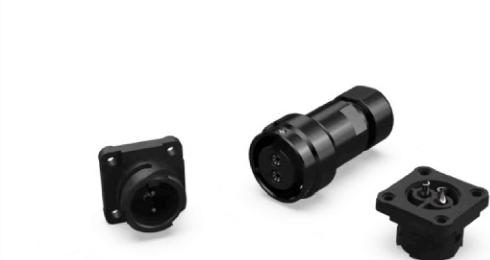
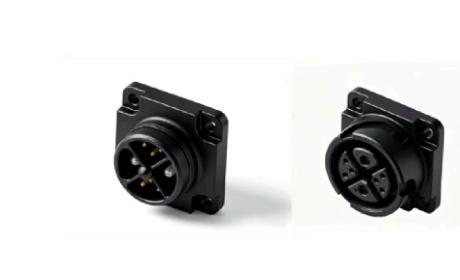
RF Circular Series Connector | RF Circular Series ConnectorA circular battery charging connector with bayonet locking and quick mating capability.
Key specifications: 2 or 3 cores; rated current 20 A/30 A; rated voltage 220 V; withstand voltage 1500 V; insulation resistance ≥500 MΩ; mechanical life 5000 cycles; -40°C to +75°C; IP67 for applicable socket/plug components. |
RF Series Wire-to-Board Connector | RF Series Wire-to-Board ConnectorA through-hole floating wire-to-board connector for battery discharge interfaces.
Key specifications: 2+8, 3+12 or 4+16 cores; rated current: power 30 A, signal 1.5 A; rated voltage: power 110 V, signal 48 V; withstand voltage: power 1500 V, signal 500 V; insulation resistance ≥500 MΩ; mechanical life 3000 cycles. |
YGC-KHSC(2+6) Battery-Swap Connector | YGC-KHSC(2+6) Battery-Swap ConnectorA connector developed for fast battery replacement and charging-support systems in robotic applications.
Key specifications: 2 power cores + 6 signal cores; rated current: power 40 A, signal 2 A; rated voltage: power 100 V DC, signal 5 V DC; withstand voltage: power 1000 V AC, signal 500 V AC; insulation resistance >200 MΩ; mechanical life >10000 cycles; insertion force <20 N; -40°C to +120°C; IP67. |
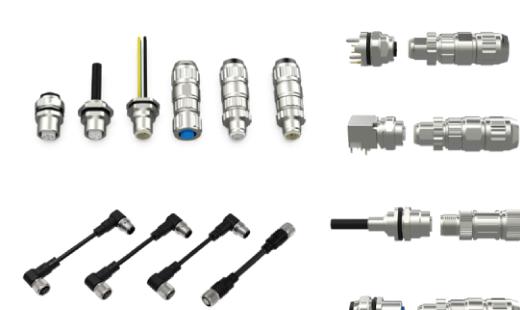
M12 Series Connector | M12 Series ConnectorA controller connector series for power and network signal transmission between robotic modules.
Key specifications: coding options include A-code, D-code, X-code and S-code; 4, 5, 8 and 12 positions; network transmission rates: 100, 1000 and 10000 Mbps; insulation resistance >100 MΩ; mechanical life >100 cycles; IP67. |
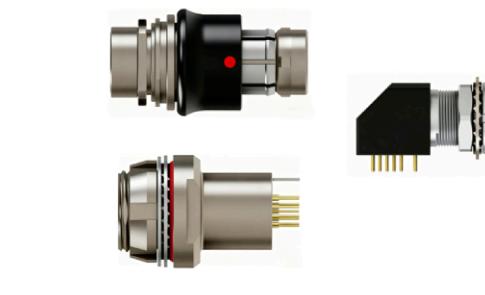
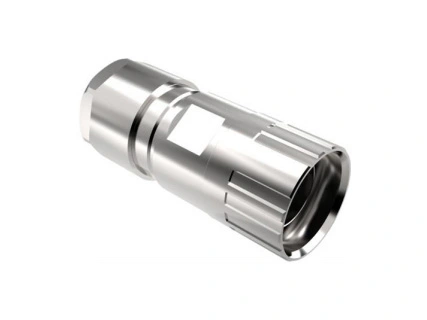
Push-Pull Series Connector | Push-Pull Series ConnectorA compact quick-plug connector family for high-density and space-constrained installations.
Key specifications: minimum shell size FX101; maximum outer diameter 12.4 mm; 360° shielding for EMC protection; supports direct transmission of USB2.0, USB3.0, HDMI, SATA, DP and Gigabit Ethernet; IP68; -55°C to +145°C. |
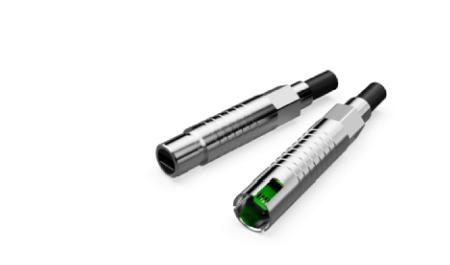
YG646 Series Type-C Feedthrough Connector | YG646 Series Type-C Feedthrough ConnectorA Type-C feedthrough connector for routing through the robot wrist or arm structure.
Key specifications: rated current 3 A; working voltage 20 V; contact resistance: initial ≤30 mΩ, after durability testing ≤50 mΩ; insulation resistance >100 MΩ at 100 V DC; impedance 85 Ω ±10 Ω; -40°C to +85°C. |
Integrated Cable Assembly Services | Integrated Cable Assembly ServicesCustomized cable assemblies for robot structures, installation space and application environments.
|

Industrial-grade interactive robotic applications create real requirements for connection reliability and assembly efficiency.
Connector performance is proven not only in the laboratory, but also in real application environments. Yonggui works with robotics industry partners across laser printing, precision testing, material feeding and other manufacturing scenarios to validate connection systems under practical operating conditions.
From component development and simulation verification to intelligent manufacturing and scenario-based validation, Yonggui focuses on building a system-level engineering capability for embodied robot connectivity. This approach supports the transition from prototype development to scalable production and helps customers build more reliable robotic platforms.
Looking ahead As embodied robots continue to move toward higher integration, lower power consumption and smarter system architectures, interconnect solutions will play a critical role in linking perception, control, motion and energy systems. Yonggui will continue to develop robot-specific connection technologies that support reliable performance in the next generation of intelligent machines. |


 English
  日本語
日本語  Deutsch
  ไทย
ไทย  русский
  العربية