𐄀 Technology Connection to Future
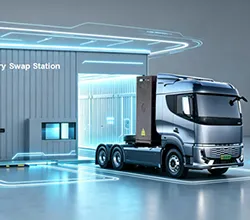


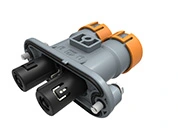
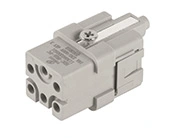

In 2026, the market penetration rate of new energy commercial vehicles is expected to exceed 35%, marking a critical stage of scaled industry growth. However, charging queues at highway service areas are becoming increasingly common. The combination of “too many vehicles and too few charging piles” and the long duration of a single charging session directly affects delivery timeliness. Low energy-replenishment efficiency has become a bottleneck for the scaled operation of new energy commercial vehicles. The emergence of the battery-swap model has completely broken this constraint: a full-power replenishment can be completed in just 3-5 minutes, comparable to the refueling speed of fuel vehicles, significantly improving commercial vehicle operating efficiency. Yet few people know that behind this efficient energy replenishment is a key core component: the battery swap connector. This seemingly modest “energy interface” is the core element that determines battery-swap efficiency, operating safety, and profitability.
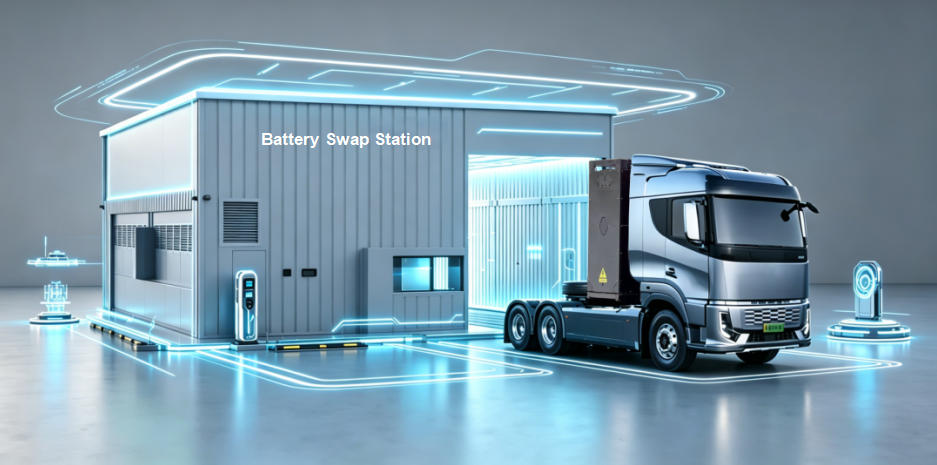

As a “critical node” in the battery-swap system of new energy vehicles, the battery swap connector is the only electrical interface of the battery pack. It integrates high-voltage, low-voltage, communication, and grounding connections, serving as the core carrier for power transmission and data exchange between the battery swap station and the vehicle. It directly determines the safety, efficiency, and reliability of the battery-swap process.
Its core structure consists of four modules: high-voltage and grounding terminals provide stable transmission of high current and high voltage to support vehicle power; signal terminals enable data exchange between the vehicle and the battery, ensuring intelligent and controllable battery swapping; the low-voltage auxiliary power supply supports stable equipment operation; and the all-round safety protection module integrates water and dust protection, overcurrent protection, and short-circuit protection to build a robust safety barrier.
Yonggui Technology has been deeply engaged in the new energy battery-swap sector. Leveraging years of technical accumulation and engineering application experience, and focusing on multi-scenario battery-swap requirements for heavy trucks, passenger vehicles, light trucks, and other applications, the company has developed a range of high-performance battery swap connector products. With standardized, highly reliable, and easy-to-maintain advantages, these products provide solid connection support for the energy-replenishment system of new energy commercial vehicles.

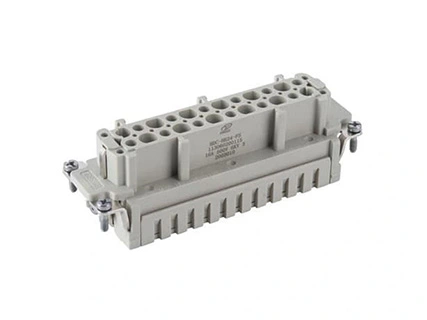
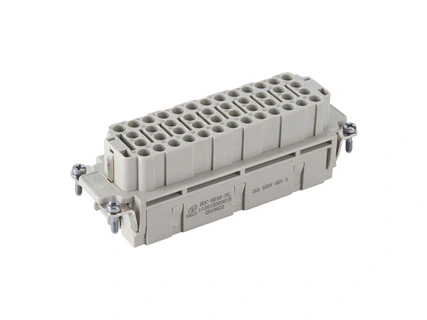
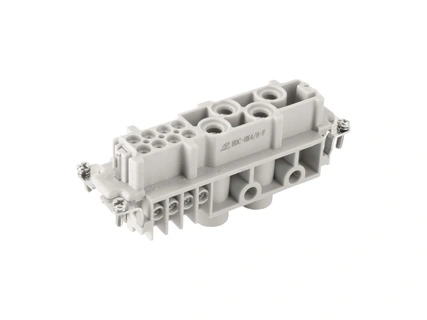
Based on deep technical expertise in battery-swap connection technology, Yonggui Technology has developed three core series of mature mass-production products. They comprehensively cover all application scenarios of new energy battery swapping and fully meet customers’ diverse and customized core requirements for battery-swap connections.
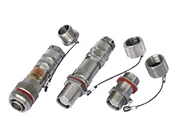
As a benchmark product compatible with the first-generation heavy-truck battery-swap system, this connector series is highly matched with the four-connector configuration for heavy trucks represented by the 282 model. Four 300 A connectors respectively undertake the connection functions of the main and auxiliary circuits, making it a mature solution verified under full market operating conditions. Its core advantages directly address key industry pain points:
Highly reliable protection for complex operating conditions. With a simple and mature structure, the complete product meets the IP67 high protection rating. It can reliably withstand dust, rain, vibration, and other complex outdoor commercial-vehicle operating environments, ensuring long-term stable operation;
Shunt-type design with excellent current-carrying performance. A multi-connector current-sharing architecture significantly improves the overall current-carrying capacity, fully meeting the high-power energy-replenishment requirements of heavy trucks and enabling stable and efficient power transmission;
Modular architecture to reduce maintenance costs. Each individual connector can operate independently. In the event of a fault, it can be removed and replaced separately without disassembling the entire system, providing outstanding maintainability in later-stage operation;
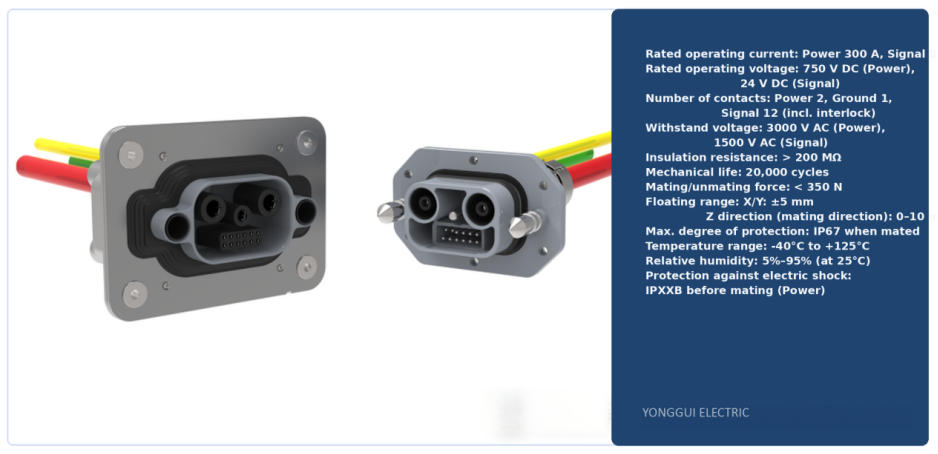
This product is an upgraded iteration developed for the standardized development of the heavy-truck battery-swap industry. It is deeply compatible with four-module heavy-truck battery-swap systems and delivers comprehensive upgrades in technical architecture, integration capability, and maintenance experience. It is a core carrier for future standardized heavy-truck battery-swap systems. Through innovative design, the product achieves industry breakthroughs:
Flexible customization for diverse layouts. It supports both 90-degree cable outlet and straight cable outlet configurations, allowing the outlet angle to be customized according to vehicle wiring requirements. This greatly improves the efficiency of vehicle layout design and adapts to diverse vehicle architectures;
Front-end quick replacement for greatly improved maintenance efficiency. With an innovative front-end tool-free contact quick-replacement structure, contacts can be quickly replaced from the mounting panel side without disassembling the connector main frame, greatly simplifying later-stage maintenance procedures;
High integration for cost reduction and efficiency improvement. A single connector highly integrates two 400 A high-power channels, one 100 A auxiliary power channel, and a 36-pin high-density signal channel. One set of this solution replaces the traditional four-connector combined architecture, effectively reducing vehicle matching costs while ensuring high-power and highly stable transmission;
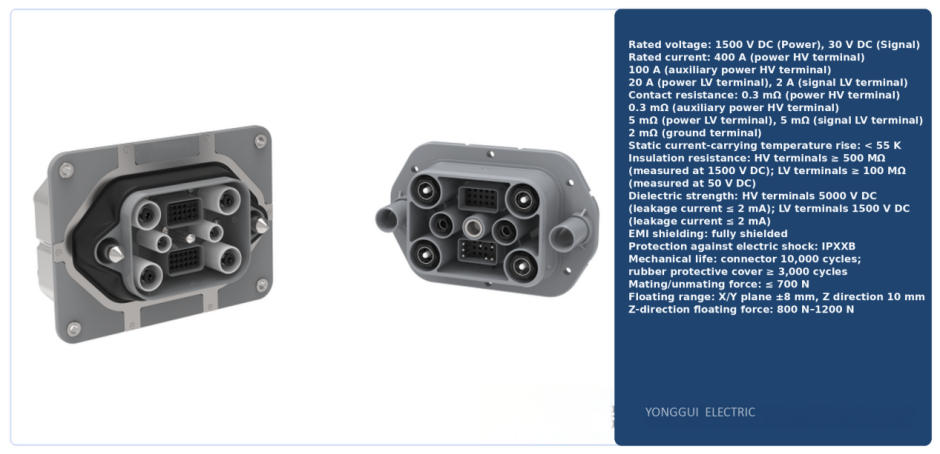
This product is an innovative solution specifically developed for split-box battery-swap schemes. With a breakthrough structural design, it removes vehicle compatibility barriers and provides core technical support for the large-scale promotion of split-box battery swapping.
Innovative dual-end-face structure for multi-purpose application. The battery-pack interface adopts a dual-mating-end-face design with a 90-degree included angle, enabling compatibility with two vehicle models that have different installation directions. When the battery pack is installed on a specified vehicle model, only the corresponding mating face engages precisely, without interfering with other vehicle structures, balancing versatility and stability;
Cross-platform compatibility to break vehicle-model barriers. It enables the same battery pack to be compatible with both passenger-vehicle chassis vertical-insertion battery-swap schemes and light-truck side-insertion battery-swap schemes, thoroughly addressing the industry pain point of non-universal battery packs across different vehicle models;
Empowering operations with significant cost reduction and efficiency improvement. It expands the range of vehicle models served by battery swap stations, significantly improves battery-pack commonality and reuse rates, effectively dilutes the construction and operating costs of the battery-swap network, and helps battery swap stations provide one-stop service for multiple vehicle models;
Targeted development with deep system collaboration. Specially customized for split-box battery-swap schemes, the product is deeply adapted to and collaboratively optimized with the battery-swap system, providing highly reliable connection assurance for the scaled implementation of split-box battery swapping.
From mature adaptation in the existing market to standard leadership for future systems, from stable and reliable performance in high-power heavy-truck scenarios to innovative compatibility across passenger and light-truck scenarios, Yonggui Technology consistently follows scenario-based demand and centers on precision connection technology to continuously build a comprehensive battery swap connector product matrix.
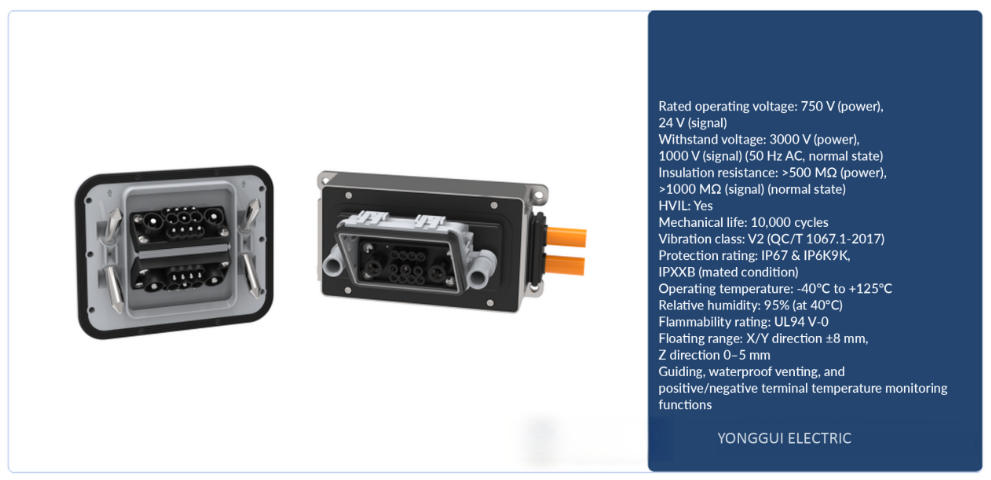

As the new energy commercial vehicle industry continues to deepen, the battery-swap model is becoming a mainstream direction for energy replenishment. The battery swap connector industry is embracing new development opportunities. Yonggui Technology will continue to increase R&D investment and promote technological innovation in four core directions:
Intelligent upgrade: Deepen the integration and application of IoT and big-data modules, incorporate remote monitoring, intelligent fault warning, and intelligent operation scheduling functions into existing battery swap connector products, draw on the quick-replacement structural design concept of the third-generation GB DC charging connector, optimize maintenance processes, further improve product maintenance efficiency, and promote the intelligent upgrade of connector production.
Technology integration innovation: Promote the deep integration of core technologies such as flat contact and quick plug-in/plug-out, and combine the company’s technical advantages in planar floating and three-dimensional floating products to create an integrated battery-swap connection solution with higher efficiency and higher reliability.
Low-carbon R&D: Based on the concept of building a “green factory,” deepen the application of lightweight, long-life, recyclable, and environmentally friendly materials; optimize product energy-efficiency design and reduce energy consumption throughout the product life cycle. At the same time, improve the green supply-chain system and integrate green design and green production into the entire R&D and production process, supporting the carbon-neutrality goals of the full new energy industry chain.
Customized development: Focus on segmented scenarios such as mining, ports, and energy storage; deepen customized solution development based on the existing three core product matrix; strengthen strategic cooperation with leading OEMs and research institutes; accurately match the differentiated needs of different scenarios and customers; and provide full-process customized services from solution design to mass-production delivery.


 English
  日本語
日本語  Deutsch
  ไทย
ไทย  русский
  العربية